The EU Precautionary Principle, Explained
The European Union requires independent scientific review before a food additive can enter the market. The United States does not always require the same. Here's how the EU system works and why the difference matters.
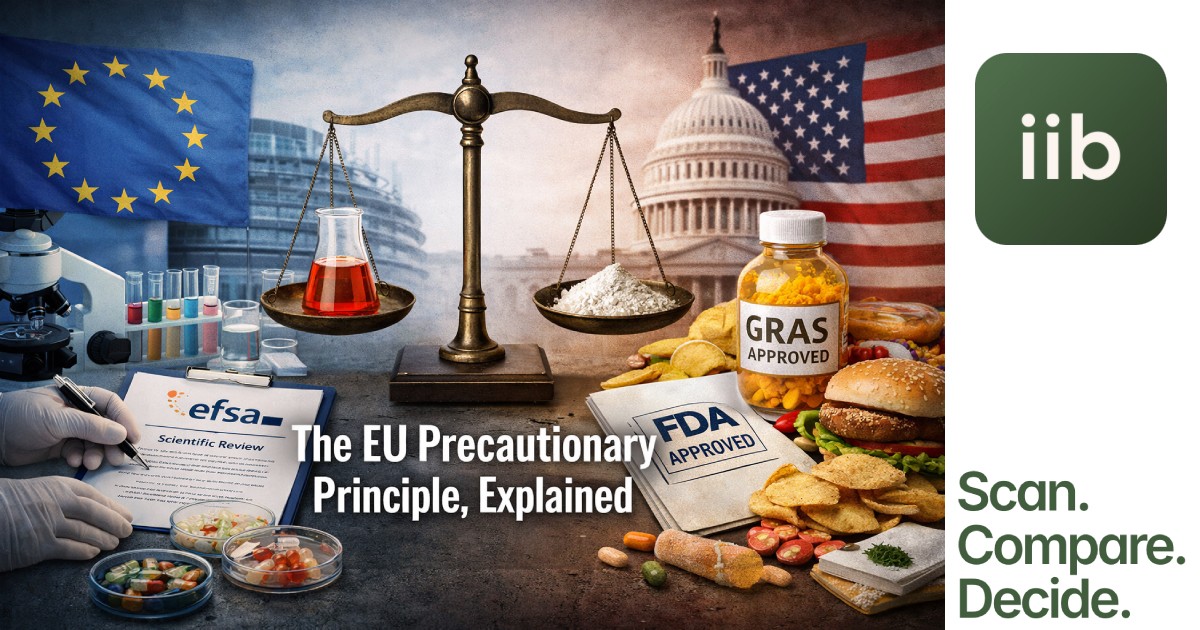
When it comes to food additives, the United States and the European Union follow very different regulatory models.
In the United States, many substances enter the food supply through the "Generally Recognized as Safe" (GRAS) pathway, which allows companies to determine safety without formal FDA approval. In the EU, every food additive must receive pre-market authorization from a government agency before it can be sold in food.
That difference in approach has a name. It's called the Precautionary Principle.
What the Precautionary Principle Actually Means
The Precautionary Principle is a regulatory philosophy embedded in EU law. In the context of food safety, it means that when scientific evidence suggests a substance could pose a risk to human health, regulators can restrict that substance even if the evidence isn't conclusive.
The US system works differently. The FDA generally requires clear evidence of harm before restricting an ingredient that's already on the market. The burden of proof falls on the regulator, not the manufacturer.
In the EU, the burden falls on the company. Before any food additive can be sold in the European market, the manufacturer must submit comprehensive safety data to the European Food Safety Authority (EFSA). EFSA conducts an independent scientific risk assessment. Only after EFSA concludes the substance is safe at proposed usage levels does the European Commission authorize it for use.
This is governed by Regulation (EC) No 1333/2008 of the European Parliament and of the Council. The authorization procedure itself is established under Regulation (EC) No 1331/2008.
How the EU Authorization Process Works
The process has several layers that don't exist in the US system.
Pre-market authorization is mandatory
No food additive can be placed on the EU market without explicit government approval. There is no self-affirmation pathway. There is no voluntary notification system. EFSA evaluates the evidence and the European Commission makes the final decision.
Every additive gets specific conditions
When an additive is authorized, it comes with defined conditions of use. That means specific food categories where it can be used, maximum permitted levels for each category, and in some cases mandatory labeling requirements. The EU does not issue blanket approvals.
Re-evaluation is built into the system
Under Commission Regulation (EU) No 257/2010, all food additives approved before January 2009 must be systematically re-evaluated by EFSA. As of early 2026, EFSA has published 136 scientific opinions covering 244 individual food additives, with 71 still pending re-evaluation. If new evidence raises concerns, the authorization can be modified or withdrawn.
EFSA panels are independent
EFSA panels are composed of independent scientific experts who must disclose conflicts of interest. The agency publishes all of its scientific opinions publicly.
What This Looks Like in Practice
Titanium dioxide (E171) is a clear example. The white pigment was used in food on both sides of the Atlantic for decades. In 2021, EFSA performed a formal updated risk assessment and concluded it could no longer be considered safe as a food additive, citing concerns about genotoxicity that could not be ruled out.
The EU banned titanium dioxide in food effective August 2022 under Regulation (EU) 2022/63.
In the United States, titanium dioxide remains approved as a color additive under 21 CFR 73.575, with a maximum usage level of 1% by weight. The FDA has not completed a comparable re-evaluation.
Both regulators reviewed similar evidence but reached different regulatory conclusions.
The food dyes known as the "Southampton Six" tell a similar story. After a 2007 study funded by the UK Food Standards Agency linked six synthetic dyes to increased hyperactivity in children, the EU required a mandatory warning label on products containing those dyes. The label reads, "may have an adverse effect on activity and attention in children."
The FDA reviewed the same study and concluded that a causal link had not been established. No warning label was required.
Why This Isn't About "Safe" vs "Unsafe"
The Precautionary Principle doesn't mean the EU has determined that US food is unsafe. It means the EU has a lower threshold for regulatory action when faced with uncertain evidence.
Two reasonable regulatory systems can look at the same body of research and reach different conclusions. The EU's approach says, "If we're not sure, restrict it until we are." The US approach says, "If we're not sure, allow it until the evidence is clearer."
Neither is objectively right or wrong. But consumers deserve to know which standard was applied to the food they're eating.
What This Means for You
iib shows you the regulatory status of every ingredient in both jurisdictions, with government citations, so you can see the differences for yourself.
Sources: Regulation (EC) No 1333/2008, Regulation (EC) No 1331/2008, Commission Regulation (EU) No 257/2010, Regulation (EU) 2022/63, 21 CFR 73.575, EFSA Re-evaluation Programme — State of Play (2025), McCann et al. (2007) Lancet Study on Food Additives and Hyperactivity