What Is GRAS? How the GRAS System Lets Some Food Additives Skip FDA Review
GRAS stands for "Generally Recognized as Safe." It's the regulatory framework that allows many substances into the American food supply without formal FDA pre-market approval. Here's how it actually works.
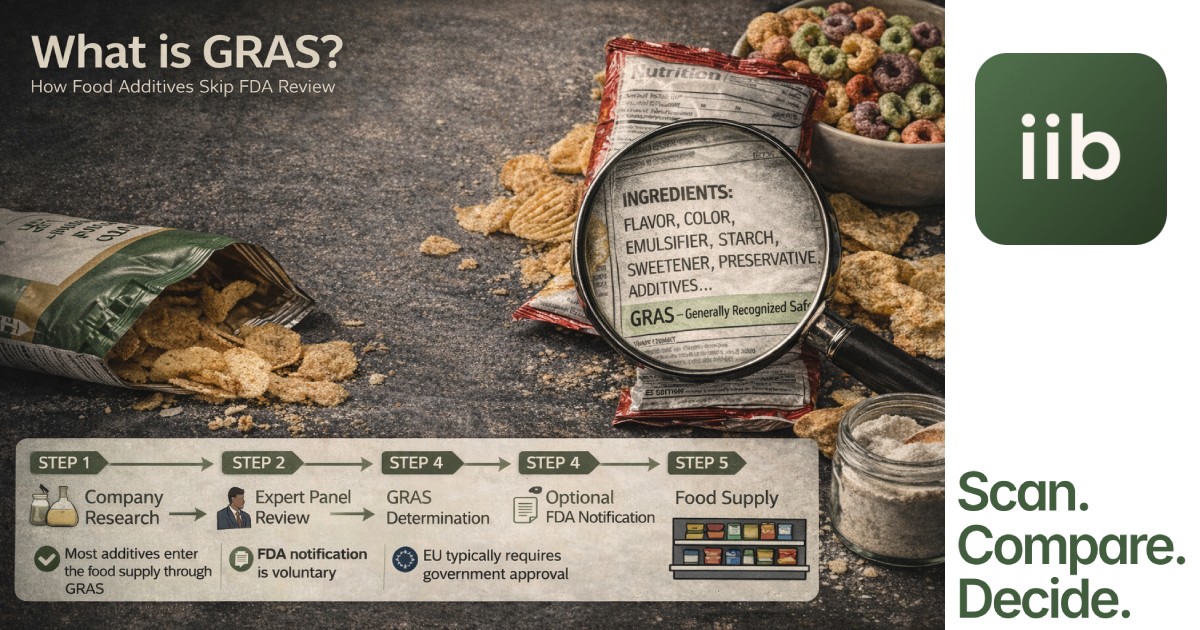
Most people assume food ingredients must be approved by the FDA before they appear in products on store shelves.
In many cases, that isn't how the system works.
Under a regulatory framework called GRAS, "Generally Recognized as Safe," companies can determine that an ingredient is safe and introduce it into the food supply without formal FDA approval.
GRAS is a designation created by the Food Additives Amendment of 1958 that exempts certain substances from the FDA's standard food additive approval process.
The original idea was simple. Ingredients like salt, vinegar, and baking powder had been used in food for centuries. Requiring manufacturers to submit formal safety petitions for those substances didn't make sense. So Congress created a carve-out. If an ingredient was "generally recognized" as safe by qualified experts, it could bypass the approval process.
That was reasonable in 1958. The problem is what happened next.
How GRAS Works Today
In 1997, the FDA proposed replacing the formal GRAS affirmation petition process with a voluntary notification system. That approach was later finalized in 2016. Under this system, a company can determine that its ingredient is GRAS and simply notify the FDA. The FDA reviews the notification and, if it doesn't object, issues a "no questions" letter.
But here's the part that surprises most people. The notification itself is voluntary.
A company can assemble its own panel of experts, conduct its own safety evaluation, and conclude that a substance is Generally Recognized as Safe without ever telling the FDA. This is called self-affirmed GRAS.
The determination and supporting data do not have to be submitted to the FDA or made public. No FDA review takes place. The FDA has acknowledged that it does not know how many self-affirmed GRAS determinations exist.
The U.S. Government Accountability Office flagged this in a 2010 report (GAO-10-246), noting that the FDA's oversight process does not ensure the safety of all new GRAS determinations.
The Three Types of GRAS
Not all GRAS substances are created equal. There are meaningful differences in how they got that designation.
Level 1. FDA-Reviewed GRAS
A company submits a GRAS notice to the FDA. FDA scientists review the evidence and issue a "no questions" letter. This is the most rigorous version of GRAS, but it still falls short of formal FDA approval. The FDA states that it has "no questions" about the company's conclusion that the ingredient is GRAS. The agency does not independently take responsibility for the safety determination.
Level 2. Self-Affirmed GRAS
A company makes its own determination, often using a hired expert panel, without notifying the FDA at all. Legal. Common. Largely invisible to consumers.
Level 3. Pre-1958 Common Use (Grandfathered GRAS)
Ingredients that were already in common use in food before the 1958 amendment were automatically considered GRAS. Many of these substances have never undergone modern toxicological testing. Some have been voluntarily re-evaluated over time. Many have not.
Why This Matters
The EU takes a fundamentally different approach. Under Regulation (EC) No 1333/2008, every food additive must receive pre-market authorization from the European Food Safety Authority (EFSA) before it can be sold in food. There is no self-affirmation pathway. There is no voluntary notification. EFSA performs the scientific risk assessment, and the European Commission makes the final authorization decision.
The EU also systematically re-evaluates previously approved additives. Under Commission Regulation (EU) No 257/2010, all food additives approved before January 2009 were systematically re-evaluated using current scientific standards. As of February 2026, EFSA has published 136 scientific opinions covering 244 individual food additives, with 71 still pending.
The result is two systems with very different levels of oversight. In the EU, a food additive has been independently evaluated by a government agency. In the US, it may have been evaluated only by the company selling it.
That's the regulatory gap.
This Is Changing
FDA leadership has signaled interest in strengthening oversight of GRAS determinations, including proposals that would require companies to notify the agency before marketing new ingredients. The FDA's Human Foods Program listed GRAS reform among its 2026 priority deliverables.
It's a significant shift. But even if finalized, new requirements would likely apply only to new substances going forward. The thousands of self-affirmed GRAS ingredients already in the food supply would remain largely unreviewed.
What This Means for You
iib shows you exactly which type of GRAS determination applies to every ingredient in a product, and how that ingredient is regulated in the EU. No scores. No opinions. Just the regulatory facts.
Sources: Food Additives Amendment of 1958, 21 CFR Part 170 Subpart E, 81 FR 54960 (2016 Final GRAS Rule), GAO Report GAO-10-246, EU Regulation (EC) No 1333/2008, Commission Regulation (EU) No 257/2010, EFSA Re-evaluation Programme Status (February 2026), FDA Human Foods Program 2026 Priority Deliverables